
From the 30-share blue-chip pack, ITC Hotels, IndusInd Bank, Mahindra & Mahindra, Sun Pharma, UltraTech Cement and NTPC were among the biggest gainers. Titan, Kotak Mahindra Bank, Nestle, Asian Paints, HCL Tech and ICICI Bank were among the laggards.

Benchmark stock indices Sensex and Nifty rallied more than 1.6 per cent to close at lifetime high levels on Thursday following buying in banking, oil and auto shares and a record dividend payout by the RBI to the government. Regaining the 75,000 level after its best single-day gain since January 29, the 30-share BSE Sensex closed at all-time peak of 75,418.04, up by 1,196.98 points or 1.61 per cent over the last close.


The rapid growth in developing Asian countries including India is widening the rich-poor divide and income inequality could threaten the stability of nations, warns the Asian Development Bank (ADB).

From the Sensex firms, Adani Ports, Eternal, Bajaj Finance, Axis Bank, Bajaj Finserv, Reliance Industries, Power Grid and NTPC were the major gainers. Sun Pharma, however, tanked over 5 per cent.
Projection for economic growth in India for this fiscal was based on oil prices at $62 a barrel, he said, adding that a $10 dollar rise in oil prices mean 1.2 per cent reduction in India's GDP growth
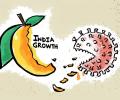
The Asian Development Bank (ADB) on Monday lowered India's growth forecast for the current fiscal to 5.6 per cent, from 7 per cent projected earlier, citing falling global demand and impact of delayed monsoon on agricultural production.

'India represents one of the top opportunities with robust growth, solid fundamentals, and openness to foreign investment.'

From the Sensex pack, NTPC, Bajaj Finance, IndusInd Bank, UltraTech Cement, Bajaj Finserv, State Bank of India, Tata Motors, ITC, Power Grid and Larsen & Toubro were the biggest gainers. IndusInd Bank climbed 2 per cent after the company on Tuesday reported a 30 per cent jump in consolidated net profit in April-June quarter at Rs 2,124.50 crore, helped by core income growth and lower bad loan provisions.

Three years after India declared its goal to become a net-zero economy by 2070, the policy design for achieving the target has begun, with the NITI Aayog forming dedicated multi-sectoral committees to prepare a transition plan. In 2021, India joined a select group of nations that set a target year for becoming net-zero carbon economy. At COP26 in Glasgow, Prime Minister Narendra Modi outlined a five-pronged 'Panchamitra' climate action target for India and committed to a net-zero target by 2070, joining nations like the US, the UK, and China.

The venture is seen as a rival to the World Bank.

Two months back the bank had made a projected the GDP growth at 5.6 per cent for the same fiscal.

Equity benchmark indices Sensex and Nifty rallied for the third session on the trot, helped by a rally in global markets after lower-than-expected consumer inflation in the US ignited hopes of more rate cuts by the Federal Reserve. The 30-share BSE index climbed 318.74 points or 0.42 per cent to revisit 77,000 level at 77,042.82.

'The intensity and frequency of heatwaves will be much higher than in previous years over Punjab, Haryana, Rajasthan, Gujarat, Madhya Pradesh and Odisha.'

Radio Free Europe reported that the Asian Infrastructure Investment Bank, a Chinese-led development bank, suspended all business with Russia and Belarus on March 3.
Union Finance Minister Pranab Mukherjee has brought about a coup in North Block by bringing an Indian Foreign Service officer Venu Rajamoni as Joint Secretary to head multilateral institutions division.

The Budget should undertake further reductions in import tariffs and seriously consider an announcement of India's intention to join one or both of the two Asian mega-regional free trade agreements, suggests Shankar Acharya, former chief economic adviser to the Government of India.

Domestic benchmark equity indices may see a positive trading sentiment on Friday thanks to a spectacular rally in world markets after the US President Donald Trump announced to put tariff hikes on hold for 90 days, excluding China from the reprieve. Indian stock markets were closed on Thursday for Shri Mahavir Jayanti. Trump has declared a three-month pause on reciprocal tariffs on non-retaliating countries marking a rather unexpected U-turn after record high levies he imposed led to global stock market meltdown.

Extending its support to Saarc Bank, Sri Lanka on Thursday said the proposed financial institution will help in alleviating poverty in the South Asian region.
The Asian Development Bank has downgraded India's economic growth forecast for the current financial year to 10 per cent on Tuesday, from 11 per cent projected in April, on account of the adverse impact of the coronavirus pandemic. India's GDP growth recovered to 1.6 per cent in the last quarter of fiscal year ended March 2021, narrowing contraction in the whole fiscal year from 8 per cent estimated in April to a revised 7.3 per cent, the multilateral funding agency said in the Asian Development Outlook (ADO) Supplement. "Then a second wave of the pandemic induced many state governments to impose strict containment measures.
However, India's economy will rebound to 8.5 per cent in 2009-10, Manila-based Asian Development Bank said in its Asian Development Outlook 2008. Narhari Rao, Principal Economist with India Resident Mission of ADB, said recent duty cuts by the government to arrest inflation, which is racing towards 7 per cent, are likely to show results in 2-3 weeks.

Deloitte India on Friday said it estimates India's GDP growth at 6.6 per cent in the current fiscal helped by consumption expenditure, exports rebound and capital flows. In its India's economic outlook report, Deloitte said the rapid growth of the middle-income class has led to rising purchasing power and even created demand for premium luxury products and services. With the expectation that the number of middle-to-high-income segments will be one in two households by 2030/31, up from one in four currently, we believe this trend will likely become further amplified, driving overall private consumer expenditure growth, it said.
Asian Development Bank has predicted that South Asian economy, 80 per cent of which is accounted for by India, will grow at a slower pace of 7.7 per cent in 2007.

The US Fed interest rate decision, trading activity of foreign investors and quarterly earnings from corporates would largely drive the momentum in the equity market this week, analysts said. Escalating tensions between India and Pakistan over the Pahalgam terror attack will also remain on investors' radar, they added.

Ajay Banga will be a 'transformative leader', who will bring expertise, experience, and innovation to the position of World Bank President, United States President Joe Biden has said after the top Indian-American business executive was confirmed as the new head of the international lender.

'Entering India is exciting, but it's also challenging. You have to be prepared for long-term investment.'
India hopes to increase its share in the quotas of multilateral development banks like the International Monetary Fund and Asian Development Bank after major stakeholders in them bring forward the issue of quota review and expanding in accordance with current realities that will give proper representation to the emerging economies.
The Indian economy is likely to slow down a little to 7.6 per cent in the fiscal year 2006 and 7.8 per cent in 2007 as consumption and investment may get affected due to higher inflation, Asian Development Bank said on Thursday.

The Asian Development Bank has approved a US$ 1.5 billion (around Rs 11,185 crore) loan to India for COVID-19 vaccine procurement.
Asian Development Bank has said that India's fiscal deficit targets are unlikely to be met this year due to large government spending and slow pace of domestic fuel price adjustment.
The money will be used for drainage systems development.
Monetary tightening to contain overheating as well as inadequate infrastructure is likely to slow down India's growth to moderate 8 per cent next fiscal against the expected 9.2 per cent, the Asian Development Bank has forecast.

India is expected to be the top recipient of remittances in 2023 as inflows increase 12.4 per cent to $125 billion, said a World Bank report on Tuesday. Mexico will come next by receiving $67 billion and China will follow it at $50 billion. The key drivers for remittance growth in 2023 are a tight labour market in the United States, high employment growth in Europe reflecting extensive leveraging of worker retention programs, and a dampening of inflation in high-income countries. India's growth in remittances is expected to halve to 12.4 per cent in 2023 from a historic peak of 24.4 per cent in 2022.
The present financial crisis in Europe and other countries is affecting Asian economies not just through trade or slower Asian exports, but through financial channels and can be compared to the Lehman shock of 2008.

'Right now, silver -- and especially platinum -- are very cheap compared to gold. If I were buying today, I would choose platinum.'

Engineering and construction major Larsen & Toubro (L&T) reported a 25 per cent rise in net profit attributable to the owners of the company for the January-March quarter of 2024-25, owing to higher revenues and an exceptional gain. For the quarter under review, L&T posted a consolidated net profit of Rs 5,497.3 crore, while revenue rose 10.9 per cent year-on-year (Y-o-Y) to Rs 74,392.28 crore.

Asian Paints dropped the most by 1.33 per cent. IndusInd bank fell 1.2 per cent, Axis Bank by 1.19 per cent, SBI by 1.12 per cent, Bajaj Finance by 1.07 per cent, Nestle by 1.04 per cent, and TCS by 0.97 per cent. Hindustan Unilever, Reliance Industries, Power Grid and Kotak Bank also retreated. Maruti Suzuki was the lead gainer, rising by 2.22 per cent.
